Views: 12
DULETAI MATERIAL GUIDES · SURFACE AND STRUCTURE
Two PVC tarpaulins look equally waterproof. Why does one stay easier to clean, while another develops marks around its cut edges? And does choosing knife-coated fabric or a PVDF finish tell you how long it will last?
Start by separating the jobs of the surface finish, the PVC barrier and the polyester reinforcement. This guide connects those layers to anti-wicking, welding, physical-performance tests and a fair knife-coated versus laminated comparison.
WATCH THE VIDEO
Watch our four-minute guide to acrylic and PVDF finishes, anti-wicking and the difference between surface protection and whole-fabric performance.
EXPLORE THE MATERIAL
Open a topic to read its explanation. Long sections scroll inside the panel; select the heading again to close it.
Find the layers and the manufacturing route
A PVC tarpaulin is a composite. Duletai uses polyester filament yarns in the woven reinforcement. That fabric, the PVC layers and any specified surface finish contribute different properties. A glossy surface does not tell you the yarn construction, and a high finished weight does not identify how much reinforcement is inside.
| Part | Main role | What to specify |
|---|---|---|
| Woven reinforcement | Provides the textile load-bearing network. Yarn, weave and direction affect mechanical behaviour. | Polyester filament yarn specification, warp/weft construction and finished-material strength. |
| PVC layer or film | Forms the main continuous barrier and contributes flexibility, handling and surface behaviour. | Formulation, finished mass/thickness, exposure and required physical performance. |
| Bonding interface | Connects coating or film to the reinforcement. | Construction and adhesion, including the failure mode after relevant conditioning. |
| Surface finish | Changes exposed-surface performance such as dirt pickup and cleanability. | Acrylic/PVDF grade, treated face, maintenance and welding requirements. |
Knife coating and lamination describe a route
Knife coating meters a PVC coating compound onto the textile before thermal processing forms the coating. Lamination joins a preformed film to the reinforcement. Bonding may use heat and pressure or an adhesive system. Ask which route is actually offered: the word laminated does not prove that a separate glue layer is present.
Neither route alone supplies a tensile value, a tear value or a service-life promise. Compare the finished constructions and the conditions in which they will work.
Knife-coated vs laminated: performance and lifespan
Two materials can have the same gsm and still use different yarns, PVC formulations and bonding structures. The table below compares the questions each route raises; it is not a league table of untested product values. Begin with a similar reinforcement, mass, intended use and exposure, then compare matched reports.
Physical performance
| Property | Knife-coated PVC | Laminated PVC | Fair comparison |
|---|---|---|---|
| Tensile strength | Depends on reinforcement, direction and finished construction. | Also depends on reinforcement, direction and finished construction. | Same tensile method, specimen width and conditioning; report warp/weft and elongation. |
| Tear resistance | Yarn, weave and the coating’s effect on yarn movement matter. | Yarn, weave and film/bonding construction matter. | Same tear method and direction. High tensile strength does not establish high tear resistance. |
| Adhesion / peel | Evaluate coating-to-textile attachment and retained adhesion after relevant ageing. | Evaluate film-to-textile attachment; assess any adhesive layer where present. | Same method, units and direction; identify which interface or material failed. |
| Flexing and cold bending | PVC formulation, plasticisation, thickness and structure govern the response. | Film formulation, bonding structure and thickness govern the response. | Distinguish repeated flexing, cold bending and static cold exposure. Match conditions and endpoints. |
| Abrasion / surface retention | Outer-layer formulation, thickness, finish and contact conditions matter. | Film formulation, finish and contact conditions matter. | Same abrasive system, load, cycles and failure criterion; inspect the relevant function after wear. |
| Appearance / gauge | Coating amount and texture can be adjusted; uniformity depends on production control. | Preformed film can support controlled appearance and film gauge; finished uniformity still needs checking. | Compare finished thickness, mass and tolerances. Smoothness is not proof of longer life. |
Water, fabrication and long-term use
| Property | Knife-coated PVC | Laminated PVC | What to verify |
|---|---|---|---|
| Water barrier / edge wicking | An intact PVC layer can resist water; exposed reinforcement and seams remain separate routes. | An intact film can also resist water; exposed edges and seams still need assessment. | Through-surface water penetration, edge wicking and seam leakage are three separate checks. |
| Welding | Weldable constructions are possible; finish and process must be qualified. | Weldable constructions are also possible; lamination does not inherently prevent welding. | Trial-weld the offered material with the proposed preparation and equipment. Assess the completed seam. |
| Lightfastness / weathering | Pigments, stabilisers, finish, colour and exposure affect results. | The same variables affect results. | Identify the product, method, scale and endpoint. No universal process-based lightfastness grade applies. |
| Long-term durability | Watch coating wear, formulation ageing, finish retention, adhesion and seams. | Watch the same properties plus long-term film-to-textile attachment and any adhesive layer. | Compare relevant aged properties, exposure history and maintenance assumptions. |
| Whole-fabric service life | A process name does not establish a fixed number of years. | A process name does not establish a fixed number of years. | Request a grade-specific expectation and its evidence, conditions, limitations and separate warranty terms. |
Practical conclusion: choose the construction that meets the application and has matching evidence. Do not assign all knife-coated fabrics a longer life, all laminates a lower strength, or either route a fixed lifespan multiplier.
What acrylic and PVDF surface finishes do
A surface finish is a thin working layer over the PVC, where specified. Suitable formulations can reduce dirt pickup, improve cleanability and slow plasticizer migration. A PVDF finish on PVC is still a finished PVC composite; it is not a PTFE-coated glass fabric or a sheet of solid PVDF.
Separate the function from the label
| Function | What it can mean | Useful evidence |
|---|---|---|
| Dirt resistance / easy cleaning | Less dirt retention or easier removal under defined conditions. | Named soil, cleaning procedure, comparison and appearance after cleaning. |
| Migration barrier | A suitable finish can reduce movement of plasticizer toward the surface. | Grade-specific assessment and compatibility with storage, printing, adhesives and cleaning. |
| Surface appearance | Gloss, matt appearance or texture can be specified. | Approved appearance sample, colour reference and agreement on variation. |
| Weather-exposed surface | The finish forms part of the material’s exposure response. | Relevant weathering, appearance and property-retention evidence for the offered material. |
Plasticizers help flexible PVC remain flexible. Their movement is one ageing mechanism among several. A finish is not a permanent seal against every ageing process, chemical or contaminant.
Repeated rubbing, folding and unsuitable cleaning can wear or damage the finish. Thickness alone does not describe coverage, adhesion or effectiveness. A micrometre figure should identify dry or wet film, the treated face or faces, the measurement method and tolerance. It is separate from total fabric thickness.
Finish function, fabric lifespan and warranty
Before comparing years, ask what the years describe. Surface appearance, ease of cleaning, a functional topcoat, the fabric’s useful service and a contractual warranty are different subjects.
| Surface treatment | Factory-supplied functional reference | How to use it |
|---|---|---|
| Acrylic finish | About 2years | Reference for surface-treatment function only, subject to the applicable grade, exposure, handling and maintenance. |
| PVDF finish | About 5years | Reference for surface-treatment function only; not a universal period for every PVDF formulation or environment. |
These are Duletai’s factory-supplied reference periods for the surface treatments discussed here. They are not whole-fabric service-life figures or unconditional warranties. For an order, agree the applicable grade, which function is being assessed, acceptable change and the conditions attached to the expectation.
A finish does not suddenly stop working on an anniversary, and a fabric does not automatically become unusable when one surface function changes. Equally, an intact-looking surface cannot prove that every seam or mechanical property remains adequate.
Keep the three statements separate
- Functional reference period: what a defined finish is expected to do under stated conditions.
- Expected fabric service life: a grade- and application-specific assessment of the whole material.
- Warranty: the written contractual coverage, exclusions and remedies.
PVDF and welding: qualify the actual grade
“PVDF” is not a complete welding instruction. Formulation, finish coverage, the faces being joined, equipment and preparation all affect fabrication. Some systems are designed for welding as supplied; others require specified treatment of the overlap. Do not transfer instructions from one formulation to another.
Duletai describes a newer PVDF finish formulation as weldable. Evaluate the specific offered grade and its procedure. Terms such as “pure PVDF” need a written definition of the formulation claim; the phrase alone does not establish resin content, eliminate preparation or guarantee a seam result.
Before production welding
- Identify the product grade, batch, finish and treated faces.
- Obtain the recommended welding route and any overlap preparation.
- Trial-weld actual production material using the intended equipment.
- Record the process settings and inspect the completed seam and failure mode.
- Where exposure warrants it, assess seam performance after relevant conditioning or ageing.
A strong coating-to-textile adhesion result is useful, but it is not a substitute for testing the fabricated weld. Conversely, a locally strong weld does not establish the durability of every coating interface.
Waterproofing, anti-wicking and mildew are separate
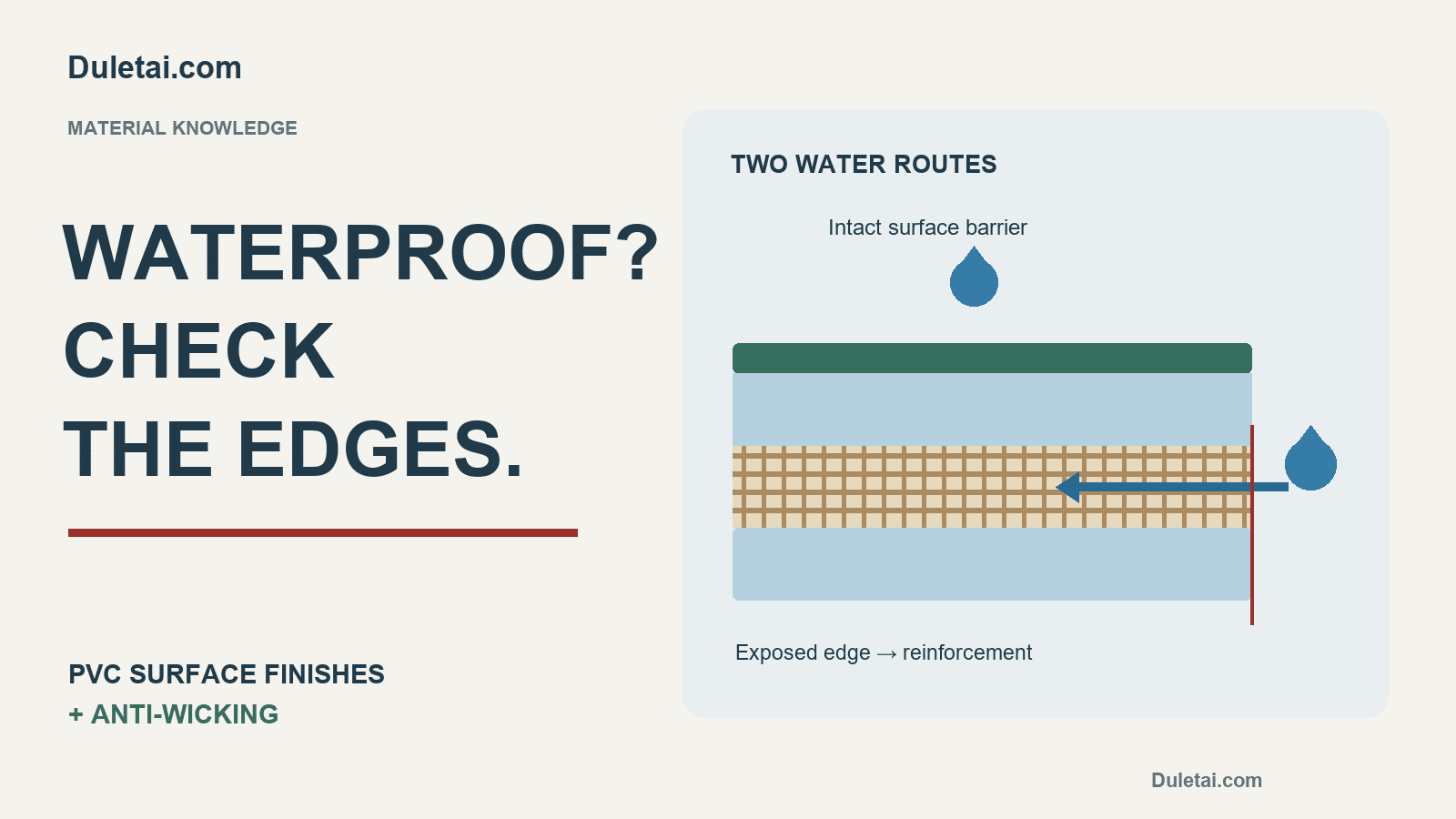
Water can follow more than one route. Resistance through an intact coated face is different from leakage at a seam, hole or fitting. At an exposed cut edge, water can contact the reinforcement and move through small spaces between filaments and yarns by capillary action.
Anti-wicking treatment aims to limit that movement through the reinforcement. It does not replace the PVC barrier, a suitable seam or a protected edge. A surface water-beading demonstration also does not, by itself, establish low edge wicking.
| Question | Relevant property | What it does not establish |
|---|---|---|
| Does water penetrate the intact face? | Resistance to through-surface water penetration under stated pressure/time. | Edge wicking or completed-seam watertightness. |
| Does water rise along exposed reinforcement? | Anti-wicking performance under a specified liquid-rise or agreed edge-exposure method. | An anti-mildew result or the lifespan of the whole material. |
| Does the material resist specified fungal growth or attack? | A suitable biological test for the material and intended use. | Low wicking, permanent stain prevention or leak-free fabrication. |
Persistent moisture and contamination can create conditions for staining or biological growth. Wicking, dirt, microbes and loss of adhesion should nevertheless be investigated separately. Water reaching reinforcement does not prove that mould or delamination must follow, or identify the sole cause of an observed defect.
Duletai’s dip-and-pad treatment sequence
Duletai describes treating the woven base fabric with an anti-wicking emulsion through a dip-and-pad process, followed by drying. The pad-treatment step is completed 24h before the subsequent production stage.
This is not a claim that the fabric remains immersed for 24h. It also does not specify a24h cure, drying temperature or chemical reaction time. Those process conditions belong to the actual production specification.
Yarn-stage and fabric-stage routes
Anti-wicking measures may be introduced at different stages. Buyers should ask how the chosen treatment is controlled and whether its effect is retained through later processing. The finished material, including exposed edges and fabricated details, is the relevant comparison.
The treatment should not be imagined as filling solid polyester filaments with liquid. Nor does the stage of application prove that one route is universally more effective. A process explanation and a matched finished-material result should support each other.
Read test reports without mixing the measurements
Record the exact method and edition, specimen construction, direction, conditioning and result units before comparing two reports. An ISO number identifies a method; it does not automatically specify a universal pass value or prove that a Duletai product was tested.
| Measurement | Example method / scope | Check before comparing |
|---|---|---|
| Tensile / elongation | ISO 1421:2016 — tensile strength and elongation; different specimen methods. | Method, specimen width, warp/weft, conditioning and elongation. |
| Tear | ISO 4674-1:2016 — constant-rate tongue or trouser tear. | Specific tear method, direction and how the force is reported. |
| Coating adhesion | ISO 2411:2024 — adhesion strength of coated fabrics. | Interface, direction, units, failure mode and any aged results. |
| Repeated flexing | ISO 7854:1995 — damage from repeated flexing using distinct methods. | Chosen method, cycles, conditioning and damage endpoint. |
| Cold bending | ISO 4675:2017 — bending after defined low-temperature exposure. | Temperature, exposure and assessed damage; do not equate this with all field cold behaviour. |
| Abrasion | ISO 5470-1:2016 — Taber abrasion of coated fabrics. | Abrasive system, load, cycles, mass loss or agreed endpoint. |
| Water penetration | ISO 1420:2016 — hydrostatic pressure and time applied to coated fabric. | Pressure/time and method. This is not an exposed-edge wicking measurement. |
| Lightfastness | ISO 105-B02 — artificial-light colour-fastness assessment. | Applicable method, colour, reference scale and result. Lightfastness is not overall weathering or service life. |
| Edge wicking | An agreed, fully described liquid-rise or edge-exposure method. | Liquid, direction, edge preparation, depth, time, reference point and number of specimens. |
What a liquid-rise comparison needs
Use the same liquid, sample preparation, direction, immersion depth, environment, duration and distance origin. Identify whether the stated result is the maximum, mean or another measure. Ink composition can change the test behaviour; an ink result should not silently become a pure-water result.
A lower rise in a matched test is useful evidence for that measurement. It cannot be converted directly into an equal-percentage improvement in strength, total performance or fabric lifespan.
Read colour grades correctly
Blue-wool references and grey-scale assessments are different reporting tools. A colour-fastness grade also needs its method and colour identified. Fading resistance does not prove coating adhesion, retained tensile strength or a guaranteed number of outdoor years.
Assess durability under the actual exposure
Outdoor service combines sunlight, temperature, moisture, pollutants and mechanical handling. Hotter, drier conditions do not automatically extend life: a change that reduces one moisture-related exposure may increase heat or UV stress. Climate descriptions alone are not a durability assessment.
For repeated-use covers, folding and contact abrasion may be decisive. For a long-term roof or enclosure, persistent moisture at details, surface condition, seam integrity and retained mechanical properties may deserve more attention. Evaluate the actual assembly rather than assigning a generic “good climate”.
Useful evidence for a service-life discussion
- The exact grade and construction used in the evidence.
- Exposure location, orientation and material temperature where relevant.
- Initial and aged appearance, adhesion, mechanical and seam properties.
- The definition of acceptable performance and its failure criterion.
- Cleaning, handling, inspection and repair assumptions.
Accelerated exposure hours cannot be multiplied by a universal factor to obtain outdoor years. A predictive claim needs correlation relevant to the material, environment and failure mode.
Melting snow can prolong wet contact around vulnerable details, but snow loading and structural adequacy are separate engineering questions. Anti-wicking treatment does not replace structural design, drainage, inspection or snow-load management.
FAQ
Is knife-coated tarpaulin always stronger than laminated tarpaulin?
No universal ranking follows from the process name. Reinforcement, formulation, bonding and finished structure matter. Compare matched tensile, tear, adhesion and relevant aged results for the offered grades.
Does PVDF mean the complete fabric will last 5years?
No. The reference of about 5years discussed here is a Duletai factory reference for surface-treatment function. Whole-fabric service life and a written warranty are separate and depend on the specified product and conditions.
Can all PVDF-finished fabrics be welded without preparation?
No. Use the procedure for the actual grade and validate a trial seam. A newer weldable formulation should be assessed on its own specification; instructions from a different PVDF system should not be assumed to apply.
Does anti-wicking replace waterproof seams or anti-mildew treatment?
No. It targets moisture movement through the reinforcement. Barrier continuity, seam watertightness and resistance to specified biological exposure require their own assessment.
Is Duletai’s base fabric immersed for 24h?
No. Duletai describes dip-and-pad treatment followed by drying, with the pad-treatment step completed 24h before subsequent production. That does not define 24h of immersion, drying or curing.
Can a liquid-rise result be converted into a fabric lifespan?
Not directly. A matched liquid-rise test measures movement under its stated conditions. A service-life prediction needs separate evidence relevant to the material, exposure and failure criteria.
Does a higher lightfastness grade prove better overall durability?
It describes colour change under a specified method, not every mechanical or chemical property. Check the method, scale and colour, then assess weathering, adhesion and mechanical retention separately.
What should I send when asking for a quotation?
Send the application, exposure location, panel dimensions, handling and joining method, required finish and water-related functions, and the reports or acceptance criteria your project needs.
REFERENCES
The following method summaries and technical education explain what measurements mean. They do not establish test results or certification for a Duletai grade. Scope information checked on 17 October 2026; agree the required edition and complete procedure with the laboratory.
- ISO 1421:2016 — tensile and elongation
- ISO 4674-1:2016 — tear methods
- ISO 2411:2024 — coating adhesion
- ISO 7854:1995 — repeated flexing
- ISO 4675:2017 — low-temperature bending
- ISO 5470-1:2016 — Taber abrasion
- ISO 1420:2016 — water penetration
- Q-Lab — lightfastness and weathering
- Q-Lab — exposure and service-life correlation