Views: 20
Flame-retardant PVC tarpaulin is designed to limit burning under specified test conditions. It is not fireproof. A useful purchase specification names the required standard, its edition, the test method and the exact fabric construction covered by the report.
For buyers of tent, membrane, awning and other industrial fabrics, the first question is not simply “Is it B1?” It is “Which standard does the project require, and does the report cover the material we will use?”
Cover design: background based on an official NIST Cube-test photograph, cropped, blurred and overlaid with the article title. Image credit: NIST. The source shows an upholstered composite laboratory test and is used here as a general fire-testing illustration.
EXPLORE THE GUIDE
Click a topic to expand it. Click the heading again to close it.
FIRE TERMS: FLAME RETARDANCY VS FIRE RESISTANCE
Reaction-to-fire tests assess how a material contributes to a fire. Fire resistance concerns how a building element or assembly maintains functions during fire exposure. A fabric reaction-to-fire classification does not establish a fire-resistance time for an entire structure.
| Term | What it tells a buyer |
|---|---|
| Flame retardant | The material has been formulated or treated to influence burning behaviour; a named test is needed to substantiate performance. |
| Reaction-to-fire classification | Performance under the relevant classification system and test conditions. |
| Fire resistance | Performance of a tested building element or assembly, rather than a general property inferred from a fabric label. |
Avoid using “fireproof” as a substitute for a test result. Write the actual standard and classification in purchase documents.
FIRE STANDARDS BY COUNTRY AND REGION
These references address different products, test arrangements and classification systems. Choose the requirement for the destination market and intended installation before selecting a material.
| Reference | Applicable country / region | Typical context | What to check |
|---|---|---|---|
| GB 8624 | China | Burning behaviour of building materials and products in China | The edition and complete classification in the report. “B1” alone is incomplete purchasing information. |
| DIN 4102-1 | Germany | German building-material classifications, including B1 and B2 | The standard designation, classification and tested construction. Do not treat a DIN B1 result as a GB B1 result. |
| EN 13501-1 | Europe (EN national adoptions) | European reaction-to-fire classification for construction products | The full code, such as B-s1,d0, and the report’s field of application. |
| NF P 92-503 / NF P 92-507 | France | French reaction-to-fire tests and M0–M4 classification of relevant interior-fitting materials; fabric specifications can name M1 or M2 | The test references and reported M classification, rather than “M1” without supporting documentation. |
| NFPA 701 | United States | Flame propagation testing of textiles and films within its scope | The applicable method, sample identification and conditioning. |
Official references: GB 8624 record, DIN 4102-1 catalogue, French electrical-burner test, French classification reference and NFPA 701.
How to read B-s1,d0
For the construction-product classification covered by the referenced European table, the three parts describe different aspects of performance.
| Part | Meaning | What it does not mean |
|---|---|---|
| B | A reaction-to-fire class based on specified test criteria | A fire-resistance rating for the completed building |
| s1 | Smoke production meets the s1 criteria | No smoke, or proof that smoke is non-toxic |
| d0 | No flaming droplets or particles occur during the specified 600s SBI test period | The material can never melt or drip under any fire exposure |
The classification criteria are set out in the European classification regulation, Annex. The table for these construction products should not be confused with the separate tables for flooring, pipe insulation or cables.
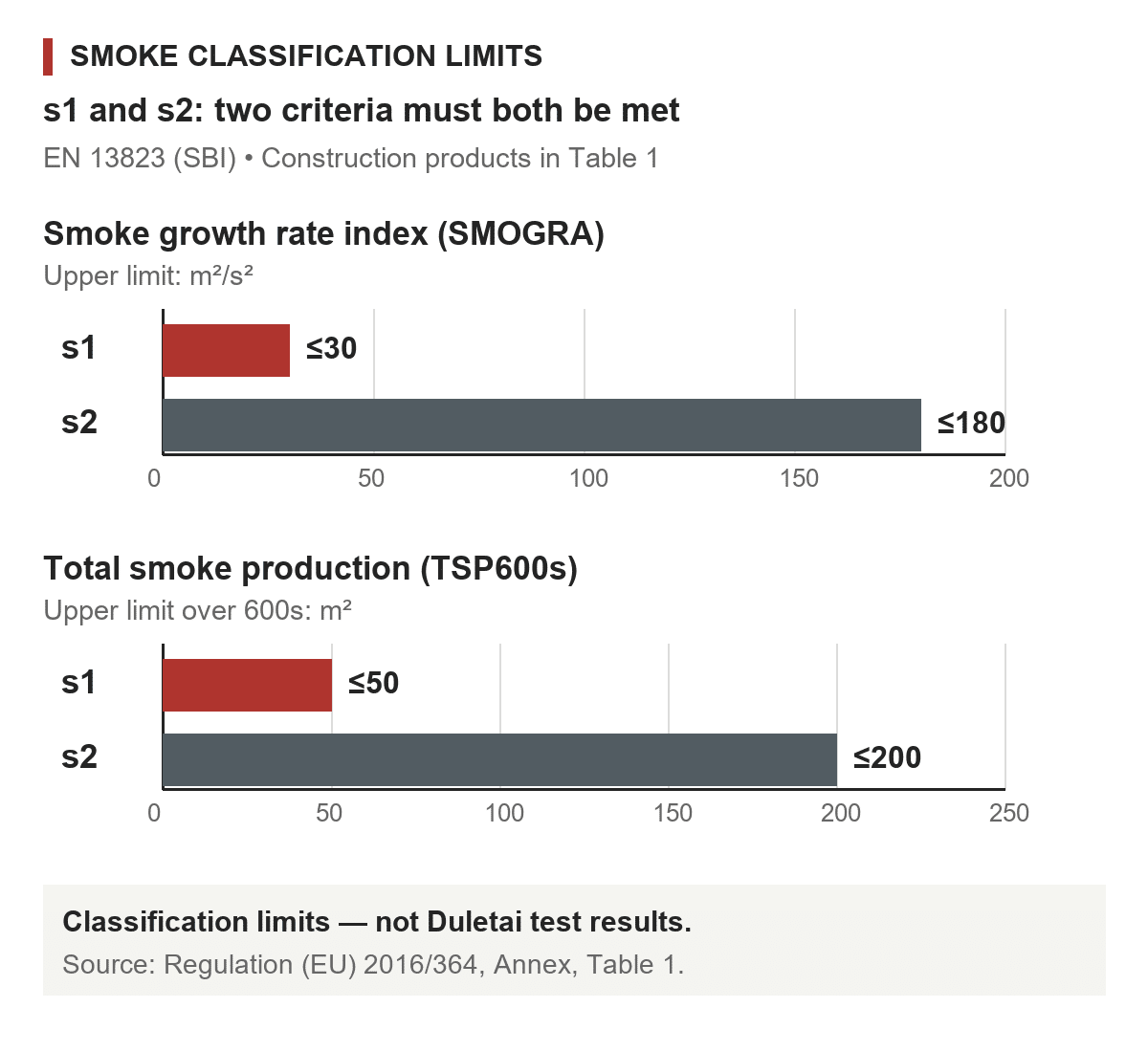
| Smoke class | SMOGRA upper limit (m²/s²) | TSP600s upper limit (m²) |
|---|---|---|
| s1 | 30 | 50 |
| s2 | 180 | 200 |
NFPA 701: select the method by scope
NFPA 701 has two methods. Method 1 covers certain materials weighing no more than 700gsm, including specified curtains and window treatments. Method 2 covers materials identified in its scope, including fabrics used for awnings, tents, tarps, membranes and banners.
A lightweight tarp does not automatically belong in Method 1. Product type, construction and use matter as well as weight. Ask the laboratory to confirm the applicable method before submitting samples.
NFPA 701 also does not provide blanket approval for interior wall, ceiling or floor finishes. The required finish or assembly test must be established separately. See the published NFPA 701:2023 scope.
California projects can involve additional registration requirements for flame-retardant chemicals and fabrics. Check the California State Fire Marshal programme and the authority responsible for the installation.
Other standards depend on the application
These references belong to different end uses. A country name identifies the standard’s origin or usual market; it does not make that standard mandatory for every fabric used there.
| Reference | Applicable country / region | Intended context | What to specify |
|---|---|---|---|
| California Title 19 | United States — California | State requirements for flame-retardant fabrics and chemicals | Check the applicable test, registration and installation requirements with the State Fire Marshal and local authority. |
| FMVSS 302 | United States | Specified vehicle interior materials | Horizontal burning-rate test; do not substitute it for a tent or building-material test. |
| CPAI-84 | United States / North American camping-tent supply chains | Flame-resistant materials used in camping tentage | A voluntary industry specification. Confirm the required document, product scope and conditioning; it is not a universal national approval. |
| CAN/ULC-S109 (ULC 109) | Canada | Flame-resistant fabrics and films for tents, awnings, draperies and decorations | Confirm the edition and applicable exposure tests. Backed interior finishes and roof coverings can require other standards. |
| BS 5867-2 | United Kingdom | Fabrics for curtains, drapes and window blinds | Identify Type A, B or C and the cleansing procedure; a curtain result does not automatically cover a tarp. |
| EN 13773 | European countries using EN national adoptions | Curtain and drape burning-behaviour classification | Confirm the classification and supporting test methods for that use. |
| AS 1530 series | Australia; other markets only when specified by the project | Fire tests on building materials, components and structures | Name the part. AS 1530.2 determines a flammability index; “AS 1530” alone is incomplete. New Zealand acceptance must be established separately. |
Sources: California programme, FMVSS 302 regulatory text, CPAI-84 explanation by its publishing association, Canadian ULC 109 scope, curtain test methods explained by SATRA and AS 1530.2 catalogue.
COMPARING B1, M1 AND NFPA 701
Do not assume that passing one test proves compliance with another. The sample arrangement, exposure, measured properties and acceptance criteria can differ. An M1 report is not evidence of an NFPA 701 pass, and a B1 label without a named standard leaves an important question unanswered.
Where project rules recognise another classification, obtain that acceptance from the relevant authority or project specification. Recognition for a particular project is different from claiming that two test methods produce equivalent results.
For example, a buyer supplying a tent should send the required standard and method to the fabric supplier and laboratory. Substituting a curtain report because both products use PVC would leave the end-use requirement unresolved.
HOW FLAME-RETARDANCY TESTS WORK
A test controls the specimen, ignition source, exposure and observations. The same material can behave differently when hung vertically, laid horizontally, backed by a substrate or incorporated into an assembly. That is why the apparatus and method belong in the specification.
From sample to reported result
| Stage | What the laboratory does | Why it matters |
|---|---|---|
| Identify and prepare | Record construction, thickness, mass, colour, exposed face and specimen directions; prepare the required dimensions. | The report must identify the material actually supplied. |
| Condition | Apply the specified temperature, humidity and any required cleaning, leaching or weathering. | Moisture and treatment durability can affect the result. |
| Mount and expose | Use the specified holder, backing, flame or radiant heat, exposure time and airflow. | Mounting and fire exposure must represent the prescribed test. |
| Measure | Observe or record the method’s ignition, burning, damage, heat, smoke or droplet indicators. | A test does not necessarily measure all these properties. |
| Evaluate and report | Compare the prescribed results with the applicable acceptance or classification criteria. | A measurement becomes a classification only through the relevant rules. |
Different apparatus answer different questions
| Test arrangement | Basic principle | Typical measurements / observations | Interpretation |
|---|---|---|---|
| Vertical flame exposure — textile and film tests such as NFPA 701 | A controlled flame exposes a suspended specimen. | Depending on the method: burning after exposure, damage or char length, mass loss and behaviour of falling material. | Use the criteria for the selected method; these observations are not interchangeable thresholds. |
| Small-flame ignition and SBI in the EN construction-product route | Small-flame tests assess ignition and spread; SBI exposes an installed corner arrangement to a burner. | Flame spread, fire growth / heat release, smoke growth / production and flaming droplets, as required for the class. | EN 13501-1 combines relevant results into a classification; SBI alone is not the whole classification system. |
| French NF P 92-503 route | Specified radiant heating and flame application challenge eligible flexible materials. | Ignition and burning behaviour under the French test conditions. | NF P 92-507 supplies classification rules; other tests may be needed for the particular product. |
| Horizontal vehicle-interior test — FMVSS 302 | A specimen is supported horizontally and exposed to a burner at one end. | Flame-front travel distance and time, used to calculate burning rate. | The regulatory limit is 102mm/min, with a stated early-extinguishment provision. This is not a vertical-tarp classification. |
| Cone calorimeter — ISO 5660-1 | Radiant heat drives decomposition; ignition is assisted by a spark. Exhaust oxygen consumption is used to determine heat release. | Ignition time, heat release, mass loss and optically measured smoke production. | Useful for development and specified verification. Cone data do not automatically award B1, M1 or an NFPA 701 pass. |
| Limiting oxygen index — LOI | The oxygen concentration in an oxygen/nitrogen atmosphere is varied to find the level that sustains burning under prescribed conditions. | Oxygen concentration, reported as a percentage. | A formulation-screening result; it does not replace the required fabric or assembly fire test. |
The cone-calorimeter principle and measurements are described by RISE’s ISO 5660-1 laboratory service. Vertical curtain-test arrangements are explained by SATRA. For exact exposure times and pass criteria, use the required edition of the standard rather than a generic online summary.
Read the measurements separately
| Indicator | Plain-language meaning | Common misunderstanding |
|---|---|---|
| Ignition time | How long a specimen takes to ignite under that exposure. | A long ignition time does not mean it cannot burn. |
| Afterflame | Continued flaming after the ignition source is removed. | Self-extinguishing in one test does not mean fireproof in a larger fire. |
| Afterglow | Continued glowing combustion without a visible flame. | No visible flame does not necessarily mean combustion has stopped. |
| Char / damaged length | How far the specimen has been affected, according to the method’s definition. | It is not a universal rating across test standards. |
| Heat release rate / total heat release | The rate and accumulated amount of heat contributed during a test. | A flame-spread result does not supply these values unless measured. |
| Smoke production | Optical smoke output or another defined smoke measurement. | Smoke quantity does not identify all toxic or corrosive gases. |
| Flaming droplets / particles | Burning material falling from the specimen during the defined observation period. | A d0 classification is limited to the stated test conditions. |
| Burning rate | Distance travelled by a flame front per unit time in the defined test. | Horizontal burning rate cannot be converted into a vertical-flame pass. |
Smouldering, smoke and fire gases can remain hazardous even when flame spread is limited. PVC fire gases can include hydrogen chloride, while incomplete combustion can produce carbon monoxide. Where smoke density, gas toxicity or corrosion matters, specify the additional assessment instead of inferring it from a flame-retardant label.
FLAME-RETARDANT MECHANISMS AND ADDITIVES
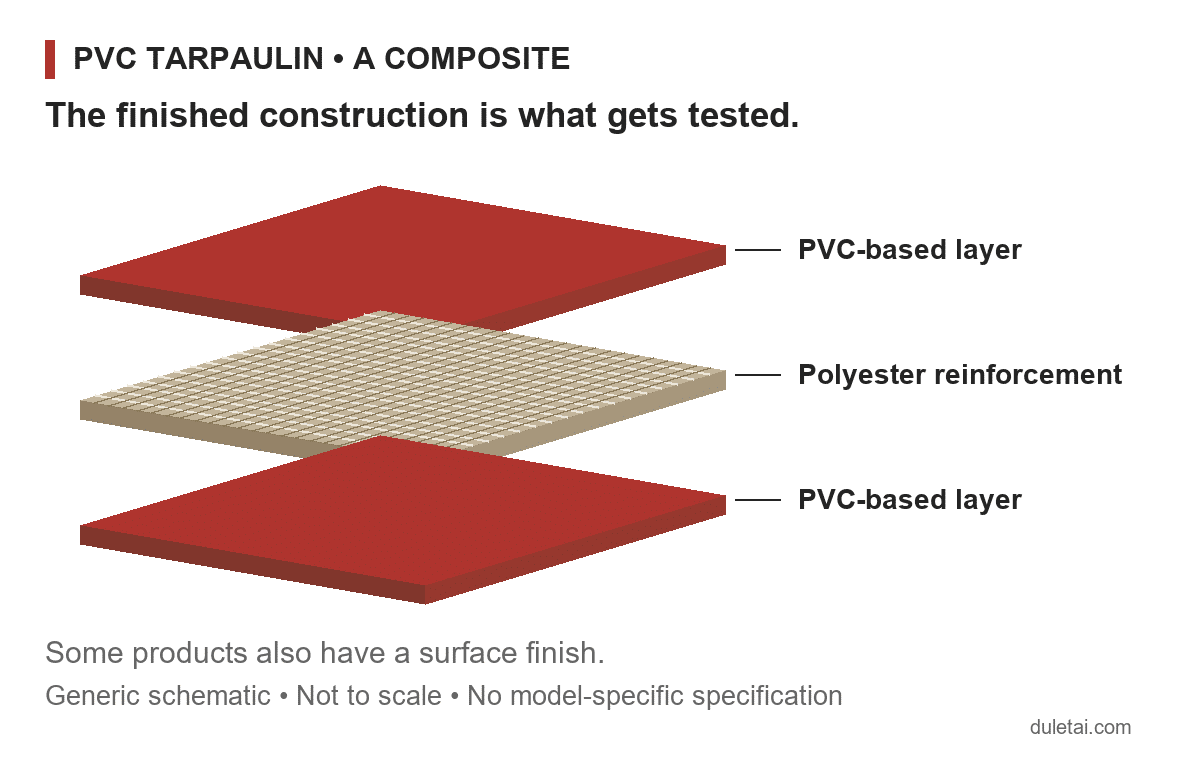
PVC tarpaulin combines a textile reinforcement with a PVC-based layer and, in some products, an additional surface finish. The tested material is this construction, not an isolated additive or a generic description of PVC.
How a burning polymer feeds a flame
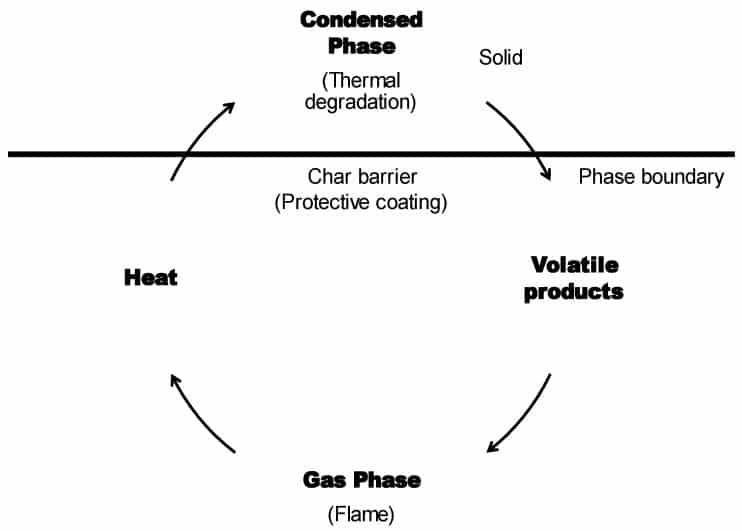
Heat causes the material to decompose and release gases. Combustible gases burn above the surface, and some of that heat returns to the material, creating more fuel. Flame-retardant systems interrupt this cycle at the flame, within the solid material, or both.
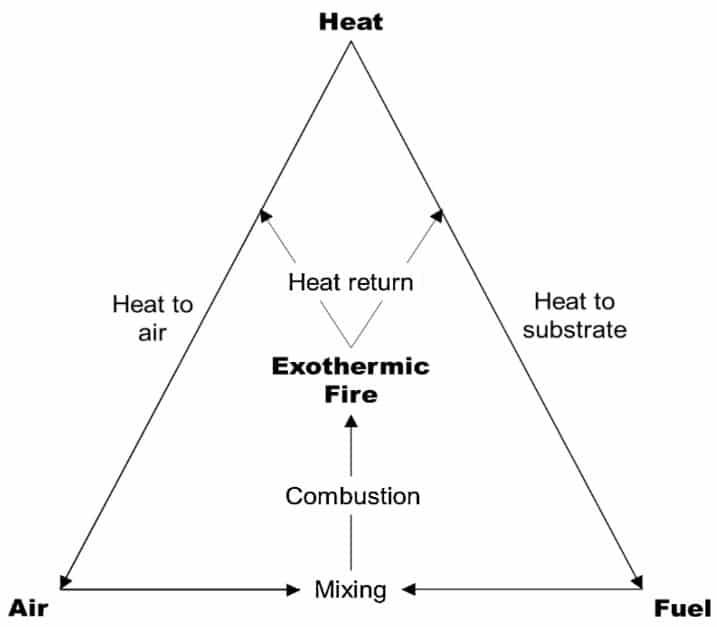
| Mechanism | What happens | Examples |
|---|---|---|
| Gas-phase inhibition | Chemical species interfere with the chain reactions sustaining the flame. | Halogen/antimony synergy; some phosphorus and brominated systems. |
| Cooling and gas dilution | Endothermic decomposition absorbs heat and releases water vapour or other non-combustible gases. | Aluminium hydroxide (ATH) and magnesium hydroxide (MDH). |
| Protective residue / char | Residue slows heat penetration and the escape of combustible decomposition products. | Char-promoting phosphorus or metal-containing systems. |
| Intumescence | A designed system forms an expanded insulating char. | Combinations of an acid source, carbon source, gas-forming agent and suitable binder. |
The mechanism can change with the chemistry and host material. A name such as “phosphorus-based” describes a family, not a guaranteed result. The mechanisms above are outlined in research on flame-retardant coatings.
Six flame-retardant additive families
| Additive family | Function in a suitable formulation | Practical considerations |
|---|---|---|
| Antimony trioxide (Sb₂O₃) with PVC chlorine | Antimony/halogen synergy helps inhibit gas-phase combustion; Sb₂O₃ is a synergist rather than a standalone guarantee. | Check customer antimony restrictions and supply cost. Removing it requires revalidating the complete formulation. |
| Phosphorus systems, including phosphate esters | Depending on chemistry, they promote protective residue and/or act in the flame. Some phosphate esters also plasticise PVC. | Check compatibility, migration, odour, surface condition, welding and printing. Not all phosphorus additives behave alike. |
| ATH / MDH mineral hydroxides | Absorb heat as they decompose and release water; the resulting mineral residue can contribute a barrier. | Loading and dispersion can affect viscosity, mass, flexibility and mechanical performance. Match decomposition behaviour to processing conditions. |
| Intumescent systems | Coordinated acid, carbon and gas-forming components build an expanded char layer. | More associated with specialised protective coatings; do not assume suitability for thin, repeatedly folded tarpaulin without trials. |
| Zinc borate and related smoke-suppression / residue-promoting additives | Can assist protective-residue formation and smoke control in suitable combinations. | Demonstrate smoke and droplet performance by the relevant tests; the additive name does not prove either result. |
| Brominated systems | Selected brominated compounds act mainly through gas-phase flame inhibition. | Not required in every PVC tarp formulation. Confirm the exact substances against destination-market rules and customer restrictions. |
Flexible-PVC studies demonstrate antimony/halogen and char-promoting approaches and a magnesium–molybdenum–phosphorus combination. Their experimental results apply to the tested research formulations, not every PVC tarpaulin.
PVC contains chlorine, but plasticisers and the polyester reinforcement can add combustible material. Their combined behaviour matters. “Antimony-free” does not mean “halogen-free”: PVC itself contains chlorine. Reduced smoke, reduced flame spread and reduced fire-gas toxicity are separate claims.
PVC FORMULATION: INGREDIENTS AND THEIR ROLES
The coating formulation has to provide fire performance and remain usable in production. Its ingredients work together; there is no single additive percentage that guarantees every standard, fabric weight and construction.
| Component | Main role | What to validate |
|---|---|---|
| PVC resin | Forms the coating or film matrix. | Resin grade, processing behaviour and the finished coating structure. |
| Plasticiser | Provides flexibility and helps processing; selected types can also contribute flame-retardant functionality. | Fire behaviour, cold flexibility, migration and compatibility with other ingredients. |
| Flame-retardant package | Supplies gas-phase inhibition, cooling or protective-residue mechanisms. | The complete fabric’s performance under the required test, not the additive’s standalone description. |
| Smoke-suppression / synergist package | Adjusts smoke or residue behaviour alongside the flame-retardant system. | The chosen smoke measurement and any separately required gas analysis. |
| Heat stabiliser | Helps control PVC degradation during processing. | Compatibility, thermal processing stability and chemical restrictions. |
| Fillers and pigments | Adjust colour, mass, texture and other properties. | Dispersion, coating uniformity and whether colour or filler changes are covered by the report. |
| Processing / dispersion aids | Help ingredients mix and the coating flow or apply consistently. | Viscosity, settling, uniform distribution and surface condition. |
| Surface finish / topcoat | Provides specified wear, cleaning, printing or weathering properties. | Compatibility with the whole construction and whether the finish alters the tested version. |
Formulation development follows a practical sequence: define the application and test → select compatible ingredients → make representative material → assess fire and processing performance → adjust the formulation → verify the final construction. Published recipes can guide development, but they are not an interchangeable production formula or proof of a classification.
Additive and reactive approaches
| Approach | How it is incorporated | What to watch |
|---|---|---|
| Additive | The flame-retardant ingredient is physically mixed into the formulation. | Dispersion and compatibility matter. Some ingredients can migrate or bloom at the surface, affecting printing, welding or appearance. |
| Reactive | A suitable chemical group is bonded into the polymer during synthesis or curing. | Bonding can reduce mobility, but performance still depends on chemistry and processing. This is not a direct replacement for a dispersed additive in conventional PVC plastisol. |
Migration is not inevitable for every additive, and chemical bonding does not eliminate every durability issue. Assess the complete system after the specified ageing, cleaning or storage conditions.
Where flame retardancy sits in the fabric
| Part of the construction | Role in flame behaviour | Question to ask |
|---|---|---|
| Polyester base fabric | Reinforces the material and can itself burn. | What yarn, weave and base-fabric mass were tested? Was the base fabric pretreated? |
| PVC coating / plastisol | Often carries the flame-retardant, plasticiser and filler packages in coated tarpaulins. | Do coating mass, distribution and formulation match the tested construction? |
| Topcoat | Alters the surface; it may add other functionality. | Is this exact finish included in the report? A thin surface finish alone does not establish the whole fabric’s rating. |
| Laminated film construction | Combines preformed film with reinforcement and interfaces. | Does the report cover this film, bonding system and layer arrangement? |
| Knife-coated construction | Applies a coating formulation directly around or onto the reinforcement. | Were coating application and processing conditions represented in the tested sample? |
A laminated advertising fabric and a knife-coated tarp can use different resin grades, layer masses and processing conditions. Copying an additive package between them without development and testing is not a reliable route to the same result.
FABRICATION, WELDING AND DURABILITY
More flame-retardant additive is not automatically better. A formulation change can affect several production properties at once. Check these on representative material before scaling up.
| Property | What a formulation or construction change may affect | Useful production check |
|---|---|---|
| Coating application | Viscosity, settling, dispersion and uniform coverage. | Mix stability and coating consistency on the intended production process. |
| High-frequency or thermal welding | Heating response, effective welding window and seam quality. | Trial the actual machine settings; assess seam strength and appearance. |
| Printing / adhesion | Surface migration, finish compatibility and ink wetting. | Print and adhesion trials using the intended ink and pretreatment. |
| Cold flexibility / folding | Stiffness, cracking or damage during low-temperature handling. | Trial folding and storage at the specified service conditions. |
| Mechanical performance | Tensile, tear and coating adhesion properties. | Confirm required mechanical tests on the final material. |
| Weathering / cleaning | Additive retention, surface condition and durability of the claimed performance. | Apply the conditioning required by the project and assess the material afterwards. |
| Weight / thickness | Additional ingredients and coating changes can alter both. | Confirm usable construction and dimensions instead of assuming that more gsm means better fire performance. |
Specify the target standard, welding process, printing system and service temperature together. For enclosed spaces, add the required smoke, gas or antistatic assessment where relevant. Fire performance does not demonstrate antistatic performance.
TEST REPORT CHECKLIST BEFORE ORDERING
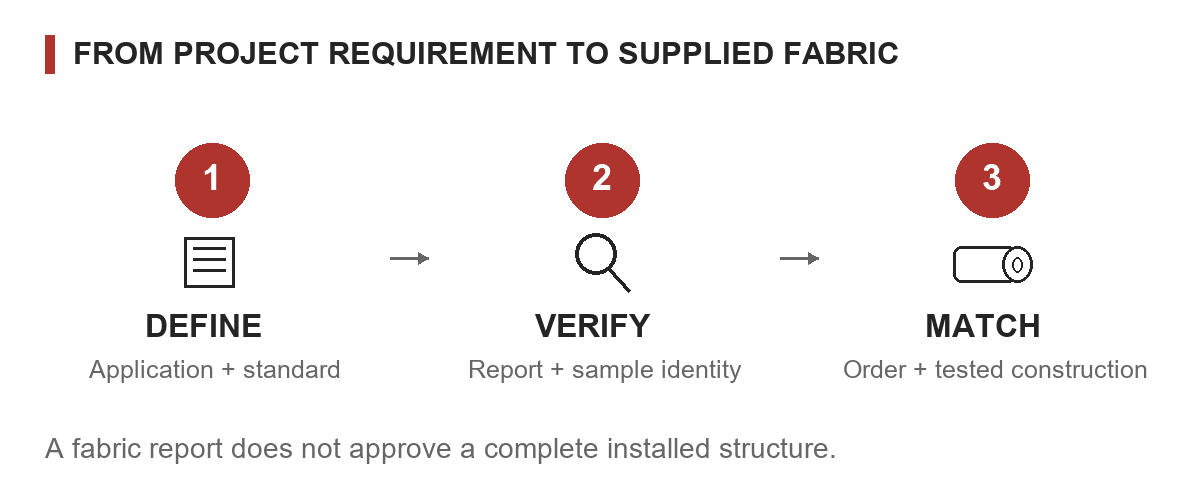
Use the following checklist when comparing material offers. Request the complete report, including sample details and any limitations, rather than relying on a badge or the report’s first page.
| Check | Information to request |
|---|---|
| Material identity | Product reference, supplier, colour, mass, thickness and construction sufficient to identify the tested sample |
| Standard and edition | Full designation, edition and applicable method |
| Result | Actual classification or pass/fail conclusion, with any qualifications |
| Sample preparation | Mounting, conditioning and any cleaning or weathering relevant to the claim |
| Application coverage | Intended use and the report’s stated field of application |
| Traceability | Laboratory, report number, issue date and a way to verify authenticity |
| Supplied construction | Confirmation that the ordered material corresponds to the report, including changes to coating or finish |
A coating, print, backing or construction change may require review of whether the existing report still applies. Ask the laboratory or responsible authority rather than assuming that every change is covered, or that every change necessarily requires the same retest.
Check fabrication separately
Fire-test documentation does not replace production trials. Before committing to an order, agree how to assess welding, seam strength, printing, flexibility and the conditions of use on representative material.
For a printed or welded finished product, ask whether the fire requirement applies to the supplied fabric, the processed product or the installed assembly. That distinction helps avoid testing a sample that does not represent the final application. A workshop lighter demonstration cannot establish a standard classification.
TESTING ORGANISATIONS AND LABORATORIES
The organisations below publish relevant testing services. Availability varies by laboratory, location and method; ask the named laboratory to confirm the exact test and accreditation scope before sending samples.
| Organisation | Published service examples | What to confirm |
|---|---|---|
| SGS | Flammability services for furniture, carpets and textiles, including NFPA 701 in its published service information. | Required edition, Method 1 or 2 as applicable, suitable specimen and the performing laboratory. |
| Intertek | Commercial-interior textile performance services, including curtain flammability references. | The required fabric / end-use method and the edition accepted by the project. |
| RISE — Research Institutes of Sweden | Furniture and furnishing fire testing and ISO 5660-1 cone calorimetry. | Whether the requested classification tests, smoke measurements or development work are within the quoted scope. |
| SATRA Technology Centre | Curtain and drape flammability testing, including BS 5867-2. | Product scope, performance type and required cleansing / conditioning. |
For an accredited report, check the laboratory’s ISO/IEC 17025 scope for the actual method, along with recognition by the buyer or project authority. A familiar organisation name alone is not proof that every branch performs every test. Listing these organisations does not imply that they have tested or certified a particular Duletai product.
FAQ: COMMON BUYER QUESTIONS
Does a higher fabric weight mean better flame retardancy?
Weight alone does not establish a fire-test result. Check the report for the actual construction and required standard instead of choosing by gsm alone.
Does s1 mean no toxic smoke?
No. It describes smoke-production performance within the classification system. It does not mean zero smoke or certify non-toxic fire gases.
Can one report cover every colour and finish?
Do not assume so. Read its sample identification and field of application, then confirm whether the ordered version is covered.
What should I send when requesting material?
Send the application, destination market, required standard and edition, classification or method, fabric construction, dimensions and processing requirements. Include any requirement for cleaning, weathering or other conditioning.
Is a flame-retardant fabric enough to approve a complete tent or membrane structure?
A fabric report is only one part of the evidence. Check the requirements for the finished product and installation with the project authority.
Can I prove flame retardancy with a lighter?
A lighter demonstration may show a sample’s behaviour under that uncontrolled exposure, but it cannot establish a standard classification. It does not control mounting, conditioning, flame, exposure time or the prescribed observations.
Does a higher LOI guarantee B1 or NFPA 701?
No. LOI measures oxygen concentration under its own conditions. The named fabric or construction-product test still has to be completed on the representative construction.
Should the PVC coating or the finished fabric be tested?
For a fabric requirement, submit the complete material covered by the purchase specification. A resin or coating result cannot automatically be applied to a composite with a different base fabric, layer mass or finish.
SELECTING MATERIAL FOR YOUR APPLICATION
Browse Duletai’s PVC tarpaulin fabrics by application. When discussing a material, provide the required standard and intended use so the supporting documentation can be checked against the specification. This guide explains standards; it does not certify a particular Duletai product.